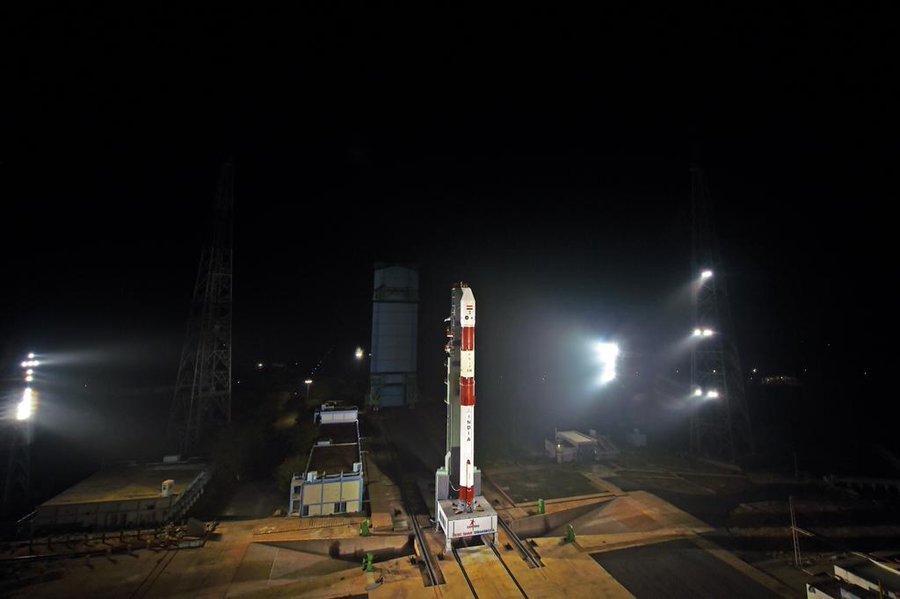
New Delhi: The Indian Space Research Organisation (ISRO) on Monday successfully launched the SpaDeX mission, achieving a historic space docking feat.
The Space Docking Experiment (SpaDeX) mission, lifted off aboard the PSLV-C60 rocket, from Sriharikota on December 30.
The SpaDeX mission is working to dock two satellites in space.
“LIFTOFF! PSLV-C60 successfully launches SpaDeX and 24 payloads,” ISRO said in a post on social media platform X.
“SpaDeX Deployed! Successful separation of SpaDeX satellites marks another milestone in India’s space journey,” it added.
India is now the fourth country, after the US, Russia, and China, to master the docking technology.
“India becomes the fourth to join the select league of nations to seek Space docking, through its own indigenously developed ‘Bharatiya Docking System’,” said Union Minister Jitendra Singh on X.
The technology will “pave the way for journey beyond the skies for “Gaganyaan” and “Bharatiya Antriksha Station”, Singh said.
SpaDeX (Space Docking Experiment) is a pioneering mission to establish India’s capability in orbital docking, a key technology for future human spaceflight and satellite servicing missions, ISRO said.
The PSLV lifted off with two small spacecraft — SDX01, the Chaser, and SDX02, the Target — weighing about 220 kg each. The satellites merged or joined for docking in a low-Earth circular orbit.
ISRO is to wait for four days for docking orientation to evaluate the software process
The Bharatiya Docking System includes a docking mechanism, a suite of four rendezvous and docking sensors, power transfer technology, indigenous novel autonomous rendezvous and docking strategy, and an inter-satellite communication link (ISL) for autonomous communication between spacecraft, incorporated with inbuilt intelligence to know the states of the other spacecraft, among others.
Mastering the space docking technology may not only propel India into the elite club of spacefaring nations. It is also key for India’s impending space missions including the Moon mission, setting up the Indian space station, and lunar missions like Chandrayaan-4 without the support of GNSS from Earth.
According to ISRO, it will also demonstrate the transfer of electric power between the docked spacecraft, which is essential for future applications such as in-space robotics — composite spacecraft control, and payload operations after undocking.
SpaDEX will also use PSLV’s fourth stage, POEM-4, for experiments. The stage also carries 24 payloads from academic institutions and startups.
-IANS
Bhubaneswar: The Odisha government has decided to carry forward its rural bridge-building programme for another…
Bhubaneswar: Seven education officials from Odisha have earned national recognition for innovative initiatives aimed at…
Bhubaneswar: The Odisha government has called upon banks to expand credit support to agriculture, MSMEs…
Bhubaneswar: Moving beyond conventional narratives of disability and awareness, Samarthya 2026 used the power of…
Bhubaneswar: Odisha is looking to take tourism beyond its established destinations by promoting smaller attractions,…
Bhubaneswar: More than 2.25 lakh students across Odisha are set to benefit from new skill…
