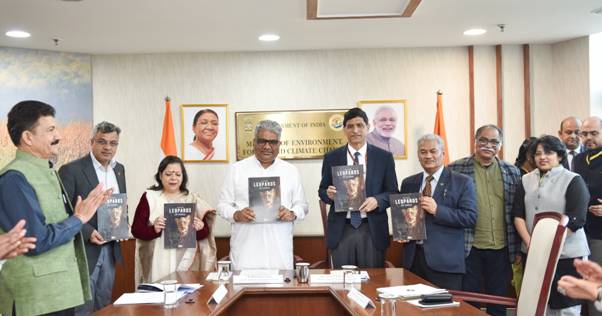
New Delhi: The much-anticipated fifth cycle report on the “Status of Leopards in India” was released today, offering a comprehensive overview of the leopard population and shedding light on the conservation challenges faced by these majestic creatures. According to the report, India’s leopard population is estimated at 13,874 individuals, indicating a stable trend compared to the previous estimate of 12,852 in 2018.
Conducted by the National Tiger Conservation Authority (NTCA) and Wildlife Institute of India in collaboration with State Forest Departments, the survey covered 70% of leopard habitat, excluding areas such as the Himalayas and semi-arid regions that are not tiger habitats. The findings provide critical insights into the distribution, abundance, and conservation status of leopards across the country.
Central India emerged as a stronghold, showcasing a stable or slightly growing leopard population, with numbers increasing from 8,071 in 2018 to 8,820 in 2022. However, challenges were observed in the Shivalik hills and Gangetic plains, where the leopard population declined from 1,253 in 2018 to 1,109 in 2022. The overall growth rate across sampled areas from 2018 to 2022 was 1.08% per annum.
Madhya Pradesh stood out as the state with the largest leopard population, hosting 3,907 individuals, followed by Maharashtra (1,985), Karnataka (1,879), and Tamil Nadu (1,070). The report underscores the critical role of Protected Areas in leopard conservation, emphasizing the need for collaborative efforts to address human-wildlife conflict and enhance habitat protection.
Union Minister Bhupender Yadav commended the broader species protection efforts and conservation commitment beyond protected areas. He emphasized the inclusive approach of Project Tiger, reflecting ecosystem interconnectedness and diverse species conservation. Minister of State for Environment, Forest and Climate Change, Ashwini Kumar Choubey, praised India’s unique community tolerance toward wildlife as a global model amid biodiversity decline.
The report serves as a crucial tool for conservation efforts, providing insights into leopard distribution and conservation challenges in India. The findings underscore the need for continued collaborative action to ensure the survival and well-being of these enigmatic big cats.
Bhubaneswar: The Odisha Cabinet, chaired by Chief Minister Mohan Charan Majhi, on Friday approved a…
Bhubaneswar: In a focused effort to create livelihood opportunities in forest regions, the Odisha government…
Bhubaneswar: Odisha showcased its rising dominance in school sports by emerging as the champion in…
Bhubaneswar: Odisha government has rolled out the Atal Bus Stand Scheme to develop modern, passenger-friendly…
Bhubaneswar: Strengthening women’s safety and empowerment mechanisms took centre stage at a high-level review meeting…
Bhubaneswar: The 8th edition of Poshan Pakhya 2026 was formally inaugurated by Union Minister Annapurna…
