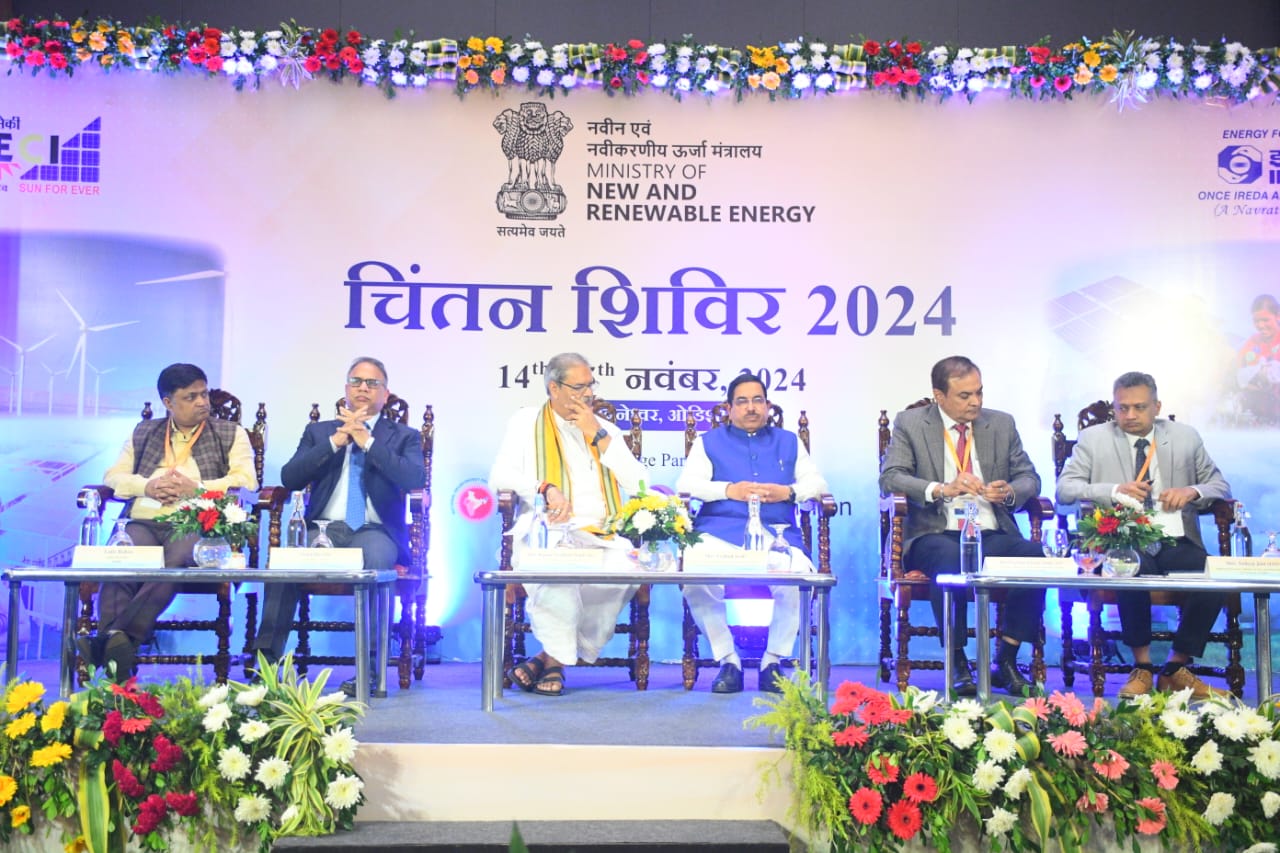
Bhubaneswar: In a major step towards achieving India’s ambitious renewable energy target of 500 GW by 2030, Union Minister of New and Renewable Energy, Pralhad Joshi, announced the formation of a dedicated task force at the valedictory session of the two-day Chintan Shivir event in Bhubaneswar, Odisha. The task force will be set up by the Ministry of New and Renewable Energy (MNRE) in collaboration with the Ministry of Power, bringing together all stakeholders to address the challenges in the renewable energy (RE) sector.
Addressing the gathering, the Union Minister emphasized the need to install an additional 288 GW of renewable energy capacity within the next six years, with an investment requirement of ₹42 lakh crore, including the necessary transmission infrastructure. He highlighted that achieving this target would require concerted efforts from all stakeholders in the sector.
The event, which saw participation from 117 industry leaders, 67 representatives from states and public sector undertakings (PSUs), and officials from 12 major renewable energy-producing states, focused on addressing critical challenges in the RE sector. Minister Joshi reiterated India’s commitment to the Panchamrit goals set by Prime Minister Narendra Modi, with a clear focus on reaching the 500 GW renewable energy target by 2030.
Furthering the government’s commitment to innovation in the RE sector, Joshi announced that MNRE would organize hackathons for startups, promoting the indigenization of renewable energy technologies. He also highlighted plans to establish a Joint Centre of Excellence for research and development (R&D) in collaboration with the Ministry of Power. These initiatives aim to foster innovation and technological advancements in the renewable energy sector.
On the regulatory front, the Minister called for the early finalization of Power Purchase Agreements (PPAs) and strict enforcement of Renewable Purchase Obligations (RPOs), crucial for ensuring the success of renewable energy projects across the country.
Joshi also turned the spotlight on Odisha’s vast renewable energy potential, especially its ability to produce 140 GW of solar capacity. He emphasized the state’s opportunity in green hydrogen production, owing to its long coastline and port infrastructure. In line with this, the Centre aims to develop Odisha as a major hub for renewable energy. He further announced that a 6,000 MW manufacturing facility for solar modules, solar cells, and ingot-wafer will be set up in Dhenkanal District, with an expected investment of ₹9,000 crore. Additionally, a 1,000 MW solar manufacturing facility is under development at Infovalley-II, Khorda, Bhubaneswar, with an investment of ₹730 crore.
Joshi also discussed the PM Surya Ghar Yojana, which is expected to achieve over 5 lakh solar installations by November 2024. He revealed that the government is considering expanding the Production Linked Incentive (PLI) scheme for domestic manufacturing of solar modules and cells to further boost the sector.
Concluding his address, Minister Joshi expressed optimism about the progress made during the Chintan Shivir, stating, “We leave this Shivir not only with a stronger sense of purpose but also with a more refined and comprehensive roadmap than we had two days ago.”
Supporting the Union Government’s efforts, Deputy Chief Minister of Odisha, Kanak Vardhan Singh Deo, reaffirmed the state’s commitment to meeting the Panchamrit targets set by Prime Minister Modi.
Secretary of MNRE, Prashant Kumar Singh, noted that the Chintan Shivir facilitated the successful exchange of ideas and that the Ministry is committed to strong inter-ministerial coordination to address challenges in the RE sector. Principal Energy Secretary of Odisha, Vishal Kumar Dev, also addressed the gathering, while Additional Secretary Sudeep Jain extended a vote of thanks to all participants.
The Chintan Shivir 2024, which commenced on November 14, covered 17 sessions on critical topics such as solar and wind energy deployment, green hydrogen, energy storage, land evacuation, transmission planning, and policy development, all focused on achieving the 500 GW target by 2030. The sessions brought together decision-makers, financial institutions, industrialists, CEOs, and government officials who are key to India’s renewable energy journey.
Kolkata: Rugby India has named a 13-member Senior Women’s Rugby Sevens squad for the Aichi-Nagoya…
Kakamigahara, Japan: India continued their dominant run at the Asian Games 2026, crushing Indonesia 17-1…
Kakamigahara, Japan: India goalkeeper Savita Punia has become the most-capped player in the history of…
Dhenkanal: A trail through the hills of Dhenkanal took heritage enthusiasts to Tapoban, a site…
Bhubaneswar: Six southern Odisha districts are set to get a new platform for rural development…
Bhubaneswar: Hospitals and health facilities across Odisha are being readied to handle emergencies and maintain…