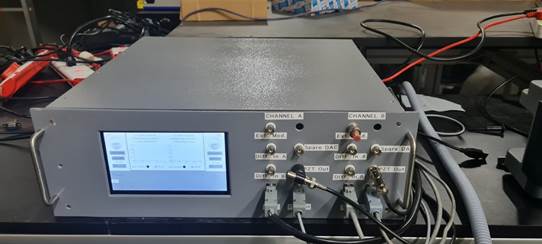
Bengaluru: India is on the cusp of a significant advancement in quantum optics with the imminent launch of multi-channel, tunable laser system technology platforms. These cutting-edge systems, developed by a spin-off company from the Raman Research Institute (RRI), promise to revolutionize quantum optics laboratories and make the technology more accessible and cost-effective for a range of applications, from medicine and remote sensing to space exploration.
At the heart of quantum optics research and applications lies high-precision laser systems, which have traditionally been prohibitively expensive. This cost barrier has hindered both research progress and the adoption of quantum technology-based industrial applications. However, the new technology from nexAtom Research and Instruments, the first spin-off company from RRI, aims to address these challenges.
The Raman Research Institute, an autonomous institute under the Department of Science & Technology, has developed the technology for these precision laser systems. The institute has awarded a license to nexAtom, which will soon begin manufacturing the multi-channel, tunable laser system platforms. RRI has also filed a provisional Indian patent for a ‘Standalone Laser System with Frequency Tunability and Precision Control.’
The initiative comes as part of India’s ambitious National Quantum Mission (NQM), launched last year with an investment of Rs. 6,000 crore. This mission aims to create an ecosystem for advancing quantum-based technology solutions, with RRI contributing significantly towards this goal.
The new laser systems, known as External Cavity Diode Lasers (ECDLs), are highly precise spectroscopic tools designed for quantum research and technology labs. These tunable laser systems are expected to support developments in quantum communication, quantum technology, quantum systems, and metrology, which are core themes of the DST-led NQM.
The development of nexAtom’s laser systems began in 2017, coinciding with the transition of laser control electronics from analog to digital technology. “Our system can be customized for various end-user requirements by tweaking the mechanical assembly for laser diodes and performing basic re-programming,” said Subodh Vashist, Founder and System Design Expert of nexAtom. “This flexibility allows us to offer solutions across medicine, remote sensing, geo-mapping, space, and marine navigation, all while eliminating the need for auxiliary systems and instruments.”
The nexAtom laser systems are available as integrated packages or sub-systems, making them highly cost-effective. This approach not only reduces overall costs but also promotes wider adoption of advanced laser technology.
RRI and nexAtom aim to set a precedent for academic entrepreneurship in India’s quantum domain. “This venture is crucial for building a high-end scientific ecosystem in the country,” remarked Professor Sadiq Rangwala, a professor at the Light and Matter group at RRI and Principal Technical Advisor to nexAtom. “The development of this prototype laser system supports the goals of the NQM and sets a template for future innovation.”
The strength of nexAtom lies in its work at RRI’s Quantum Interactions (QuaInt) lab, which has accumulated over two decades of expertise in quantum system interactions. This multi-disciplinary approach has led to the development of various products that support research and self-reliance in quantum physics.
In addition to the precision tunable laser system, nexAtom’s product lineup includes precision time taggers for quantum applications, ultra-fast seed fibre lasers, and Q-switched fibre and diode lasers for metal 3D printing, among others.
As India prepares to make a ‘quantum’ leap through the NQM, there will be a growing demand for customized lasers and associated instruments. This, in turn, will require a skilled workforce capable of developing and working with indigenous quantum technology solutions. “We need skilled engineers and PhDs who can operate within an interdisciplinary environment to build high-quality and reliable laser systems,” said Prof. Rangwala.
The introduction of these new laser systems marks a pivotal moment in India’s quantum technology journey, promising to enhance the country’s capabilities and contributions to the global scientific community.