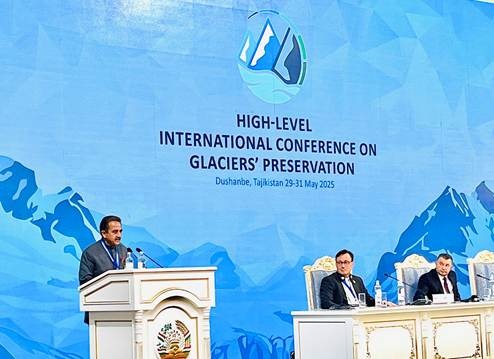
Dushanbe: Union Minister of State for Environment, Forest and Climate Change, Singh, addressed the Plenary Session of the High-Level International Conference on Glaciers’ Preservation held from May 29 to 31 in Dushanbe, Republic of Tajikistan. The international conference brought together ministers, policymakers, and scientific experts to discuss urgent strategies to protect glaciers, which are rapidly retreating due to climate change and serve as vital freshwater sources for billions across the globe.
In his address, Singh warned that the retreat of glaciers is no longer a distant threat but a present-day crisis with wide-ranging consequences for global water security, biodiversity, and the livelihoods of people, particularly those in vulnerable mountainous regions. He highlighted the disproportionate impact of glacial melt on the Himalayas, stressing India’s unique vulnerability as well as its leadership in climate action.
Underscoring India’s strategic interventions, the Minister outlined initiatives under the National Mission for Sustaining the Himalayan Ecosystem (NMSHE), a core component of India’s National Action Plan on Climate Change (NAPCC). He also mentioned the establishment of the Centre for Cryosphere and Climate Change Studies, which is advancing scientific research and long-term glacier monitoring in the Indian Himalayan Region.
Singh noted that India is harnessing advanced Remote Sensing and GIS technologies—spearheaded by the Indian Space Research Organisation (ISRO)—to monitor glacier mass, extent, and movement. This technological edge is complemented by the research of national institutions such as the National Centre for Polar and Ocean Research (NCPOR), the National Institute of Hydrology (NIH), the Wadia Institute of Himalayan Geology, and the G.B. Pant National Institute of Himalayan Environment (NIHE), all working together to build a robust knowledge base for evidence-based policymaking.
To bolster disaster resilience, India has enhanced its early warning systems and Glacial Lake Outburst Flood (GLOF) risk mapping through the National Disaster Management Authority (NDMA). Singh emphasized the importance of regional cooperation in sharing data and harmonizing responses to the cascading threats posed by climate-induced glacier melt.
On the global stage, the Minister reiterated India’s steadfast commitment to the principle of Common but Differentiated Responsibilities and Respective Capabilities (CBDR–RC), pointing out that South Asia—despite contributing minimally to cumulative global emissions—remains among the most climate-vulnerable regions.
Singh highlighted India’s achievements under the leadership of Prime Minister Narendra Modi, including sourcing over 48% of the country’s electricity capacity from non-fossil fuel-based energy, reducing the emission intensity of GDP by 36% between 2005 and 2020, and creating an additional carbon sink of 2.29 billion tonnes of CO₂ equivalent between 2005 and 2021 through enhanced forest and tree cover.
The Minister called for climate action to be shaped by national circumstances and development priorities, advocating for differentiated approaches to adaptation and mitigation efforts. He welcomed the declaration of 2025 as the International Year of Glaciers’ Preservation and the upcoming Decade of Action for Cryospheric Sciences (2025–2034).
In his closing remarks, Singh urged the international community to strengthen collaboration, expand scientific partnerships, and ensure greater financial and technological support for developing nations. He affirmed India’s readiness to lead by example, share expertise, and contribute meaningfully to global efforts aimed at preserving glaciers and securing a climate-resilient future for all.
Bhubaneswar: With physical tests for the recruitment of Foresters, Forest Guards and Excise Constables set…
Bhubaneswar: Adapting government communication to the rapidly evolving digital and artificial intelligence (AI) landscape while…
Bhubaneswar: Olympian hockey player and East Coast Railway (ECoR) Sports Officer Amit Rohidas was felicitated…
Bhubaneswar: In a major push to expand egg production and attract investment in the poultry…
Bhubaneswar: The Information and Public Relations (I&PR) Department organised a one-day orientation programme on “Emerging…
Bhubaneswar: Odisha’s disaster management model continues to draw interest from students pursuing disaster management studies,…
