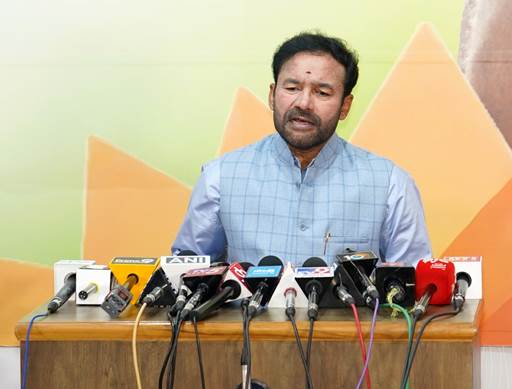
New Delhi: The Government of India has reiterated its commitment to preserving, promoting, and developing the nation’s rich linguistic heritage, underscoring the pivotal role of languages in cultural development and national unity. Speaking at a press conference today, Union Minister G. Kishan Reddy highlighted the government’s vision for a developed India by 2047, emphasizing that India’s linguistic diversity is a global exemplar of cultural richness.
“Languages in India are more than tools of communication; they are repositories of knowledge, culture, and traditions,” said Reddy. Reflecting on historical challenges, the Minister mentioned the adverse impact of colonial policies, such as Macaulay’s 1835 reforms, which marginalized Indian languages in favor of English. He praised the government’s consistent efforts to restore the prominence of regional languages, describing them as instruments of empowerment and cultural expression.
The Minister highlighted the importance of the Eighth Schedule of the Constitution, which initially recognized 14 languages but now includes 22, showcasing India’s linguistic diversity. Landmark decisions, such as the addition of Sindhi in 1967 and Bodo, Dogri, Maithili, and Santhali in 2003 under the leadership of Atal Bihari Vajpayee, reflect the government’s dedication to honoring India’s regional and tribal languages. Recent developments include granting classical language status to Marathi, Pali, Prakrit, Assamese, and Bengali, increasing the total to 11—a world record.
The National Education Policy (NEP) 2020 has been a transformative step in promoting mother-tongue education. Shri Reddy outlined initiatives like introducing primary school books in 22 states and union territories in local languages, conducting competitive exams in 13 regional languages, and offering undergraduate programs in 12 Indian languages. Additionally, digital platforms like DIKSHA and the National Digital Library have expanded access to multilingual educational content.
Technological advancements, such as the National Language Translation Mission and the Bhashini Project, aim to bridge linguistic divides, enabling seamless communication across India’s diverse population.
Programs under Ek Bharat Shreshtha Bharat, such as the Kashi Tamil Sangamam, celebrate India’s linguistic and cultural unity, fostering connections between regions and promoting cultural exchange. Shri Reddy also emphasized the global significance of Tamil, one of the world’s oldest languages, and the collective responsibility to preserve India’s linguistic heritage.
The government envisions making Indian languages globally competitive, ensuring modern education is accessible in regional languages, and promoting linguistic pride through initiatives like literature festivals and tourism. As Prime Minister Narendra Modi stated in Mann Ki Baat, “Just as we cannot abandon our mother, we cannot abandon our mother tongue.”
Bhubaneswar: Property registration in Odisha is set for a major overhaul, with the State Government…
Hyderabad/Bhubaneswar: Odisha clinched the 11th Junior National Rugby 7s Championship (Girls) title after defeating Maharashtra…
Bhubaneswar: The Odisha Government has commenced the selection process for the Mukhyamantri Research Fellowship 2026-27,…
Bhubaneswar: Flood management, inter-state river disputes, infrastructure projects and digital governance dominated discussions at the…
Bhubaneswar: Odisha received a major boost to its railway network on Saturday with the launch…
Bhubaneswar: With continuous rainfall pushing up the water level of the Baitarani River, the Odisha…