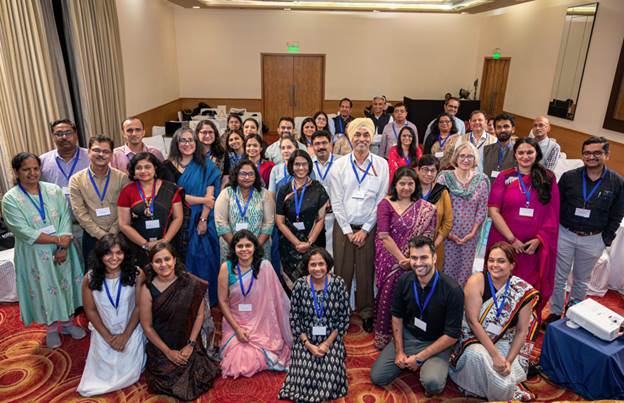
New Delhi: In a resolute statement at the “Reimagining Poverty Alleviation in India” roundtable, Charanjit Singh, Additional Secretary of Rural Livelihoods at the Ministry of Rural Development, emphasized the government’s unwavering commitment to combat climate change and poverty by ensuring inclusive livelihoods. The exclusive event was organized by the Abdul Latif Jameel Poverty Action Lab (J-PAL) South Asia.
Singh articulated the government’s vision, driven by Prime Minister Narendra Modi’s goal of making India a developed nation by 2047. He stated, “No one should be left behind,” highlighting the necessity to address the unique challenges faced by impoverished women across different states. He stressed the importance of leveraging local community knowledge to identify and solve these challenges.
Highlighting the Ministry’s innovative partnerships under the Deendayal Antyodaya Yojana-National Rural Livelihoods Mission (DAY-NRLM), Singh underscored the need for multi-stakeholder collaborations to eradicate poverty effectively. “If we work together, we can make a lot of difference,” he added.
Singh revealed that DAY-NRLM has successfully mobilized over 10.04 crore women into more than 90.76 lakh self-help groups. The mission promotes financial inclusion, digital literacy, sustainable livelihoods, and social development interventions, embodying a holistic and inclusive approach to livelihood development for women.
Joint Secretary of Rural Livelihoods, Smriti Sharan, further elaborated on the Ministry’s close collaboration with state governments to ensure the effective implementation of innovative projects modeled on the Graduation Approach. This approach aims to guide rural women towards self-sufficiency, with states adapting the program based on their priorities and ensuring that poor households benefit from other social protection programs. Sharan emphasized the need for scientific evidence, data, and technology to tackle the multifaceted nature of poverty, advocating for a broader definition beyond mere monetary poverty.
J-PAL co-founder and Nobel Laureate Abhijit Banerjee lauded the Graduation Approach model, citing its critical role in empowering the poor. “These people are excluded, but as soon as they get a chance, they begin taking charge of their lives,” Banerjee noted.
The Graduation Approach, developed by NGO BRAC, is one of the most rigorously tested social protection programs globally. Seven randomized evaluations by researchers affiliated with J-PAL and Innovations for Poverty Action have validated its effectiveness in lifting poor households out of poverty. The program has reached over 3 million households across 15 countries.
Bhubaneswar: Chief Minister Mohan Charan Majhi on Sunday inaugurated two affordable housing projects in Bhubaneswar,…
Bhubaneswar: Odisha has received the prestigious ‘Wind India 2026: Leadership in Wind Energy De-risking’ award…
Bhubaneswar: The Police Commissionerate, Bhubaneswar-Cuttack, has announced traffic restrictions across Bhubaneswar from October 16 to…
Bhubaneswar: To manage the expected rise in passenger traffic during the upcoming Durga Puja and…
Greater Noida: Odisha’s traditional handlooms and handicrafts are attracting buyers and visitors from India and…
Bhubaneswar: Food vendors at this year's Bali Jatra in Cuttack will be encouraged to use…