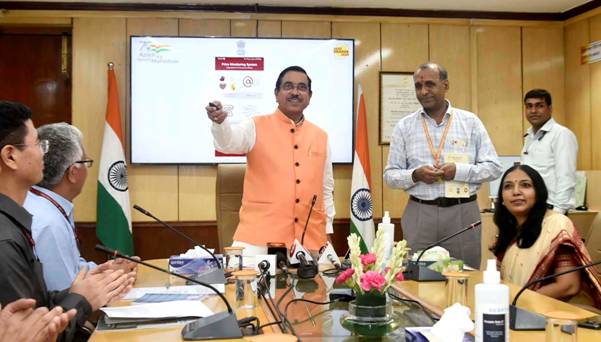
New Delhi: In a significant move to enhance food price stability, the Department of Consumer Affairs, Government of India, has included 16 additional commodities under its Price Monitoring System (PMS), effective from August 1, 2024. Union Minister of Consumer Affairs, Food and Public Distribution & New and Renewable Energy, Pralhad Venkatesh Joshi, announced this expansion while launching the Version 4.0 Price Monitoring System (PMS) Mobile App today.
Previously, the department monitored daily prices of 22 commodities. With the addition of the new items, the total number of commodities under surveillance has increased to 38. The department gathers price data from 550 centers across 34 States and Union Territories. This data is crucial for informing policy decisions by the Government, Reserve Bank of India (RBI), and analysts regarding Consumer Price Index (CPI) inflation. The newly added items include Bajra, Jowar, Ragi, Suji (wheat), Maida (wheat), Besan, Ghee, Butter, Brinjal, Egg, Black Pepper, Coriander, Cumin seed, Red chillies, Turmeric powder, and Banana. These additions bring the total coverage to approximately 31% of CPI weights, up from 26.5%.
“This expansion in coverage will play a crucial role in stabilizing food price volatility and controlling overall inflation,” said Minister Joshi. “It underscores the Government’s commitment to ensuring the availability and affordability of essential commodities for consumers.”
In recent months, the Government of India has implemented several measures to combat food price inflation. These measures include offering Bharat Chana Dal at Rs.60 per kg, Bharat Atta at Rs.27.50 per kg, and Bharat Rice at Rs.29 per kg to retail consumers. Additionally, the National Cooperative Consumers’ Federation of India (NCCF) began retailing tomatoes at Rs.60 per kg from July 29, 2024. To prevent hoarding, stock limits have been imposed on Tur and Desi Chana from June 21, 2024, to September 30, 2024. The Government has also allowed the import of pulses such as Tur, Urad, Masur, Yellow Peas, and Desi Chana at zero duty to boost domestic supply and is building a buffer stock of 5 LMT for release during lean months.
These price control measures, combined with robust progress in the sown area under Kharif pulses for the year 2024-25, have helped stabilize the market. Prices of Chana, Tur, and Urad in major mandis have declined by up to 4% over the past month. This declining trend in mandi prices is now being reflected in retail prices, with the all-India average retail prices of pulses showing a week-on-week decline.