One of the 17 Sustainable Development Goals (SDGs) established by the United Nations is to achieve gender equality and empower all women and girls. This goal recognizes the pivotal role that women play in reducing poverty, ensuring food security, and enhancing nutrition. The empowerment of women and girls hinges on the availability of equitable, high-quality education accessible to all.
In the context of indigenous tribal communities in Odisha, gender roles and inequalities have historically been shaped by cultural and economic practices. Unlike in many other societies, there was no stigma associated with widowhood among tribal women, and girls enjoyed the right to decide their marriage partners.
Additionally, tribal women could divorce and remarry with relative ease. However, they often lacked property rights, except in some matrilineal communities. Furthermore, they were barred from holding priestly positions, touching ploughs, and participating in ancestral worship, though they were allowed to work outside the home and contribute to their family’s economic activities. These practices varied among different tribal communities.
In Odisha, there are 62 distinct tribal communities, with 13 designated as particularly vulnerable tribal groups (PVTGs). According to the 2011 census, indigenous peoples make up 22.85 percent of Odisha’s total population. However, the literacy rate among tribal communities is notably lower than the state average, with tribal women facing even greater educational disparities.
Education
Recognizing that education serves as the foundation for empowerment, the government has embarked on initiatives to establish more educational facilities and facilitate tribal girls’ access to quality education. Special schools have been set up in tribal-dominated areas, complete with residential facilities, to provide indigenous children with improved educational opportunities, with a particular focus on tribal girls. These initiatives extend beyond infrastructure development; they also encompass various entitlements designed to ensure a smooth and productive educational experience for these children. Moreover, multilingual education has been introduced to make learning more enjoyable and inclusive for indigenous children, with an emphasis on involving their parents as partners in their education.
A decade ago, school dropout rates among tribal children, especially girls, were a cause for concern. However, proactive measures addressing the concerns of both children and their parents, coupled with numerous entitlements, have yielded positive outcomes. The proliferation of hostels in these districts, along with dedicated staff creating a nurturing home-away-from-home environment for these children, and modern yet indigenous-friendly teaching methods, have contributed significantly to reducing school dropouts.
Livelihood
As many tribal communities heavily depend on forests and forest products for their livelihoods, the government has taken steps to provide alternative livelihood options while also securing their rights to forest land. Odisha has made substantial progress in ensuring individual land rights within forested areas. The state government has recently introduced the Mo Jungle Jami Yojana, a scheme aimed at fostering regenerative economic opportunities for forest dwellers while also ensuring community rights over forest land. This initiative has particularly benefited women, as they have been granted forest land rights in many cases. Additionally, women participate in livelihood projects as part of Self-Help Groups (SHGs), further contributing to their economic empowerment.
Culture
Each tribal community in Odisha possesses its own unique traditions and cultural practices. In an era of rapid globalization, maintaining cultural uniqueness has become a significant challenge. To address this concern, the state government has launched initiatives such as the Special Development Council (SDC), providing tribal communities with a platform to create regulations for the preservation of their cultural identity. These initiatives have led to the restoration and rejuvenation of thousands of sacred groves, exclusive to tribal communities, with active involvement from community members. Furthermore, the music and dance of indigenous communities are safeguarded and promoted with government assistance.
Observe to Act (O2A)
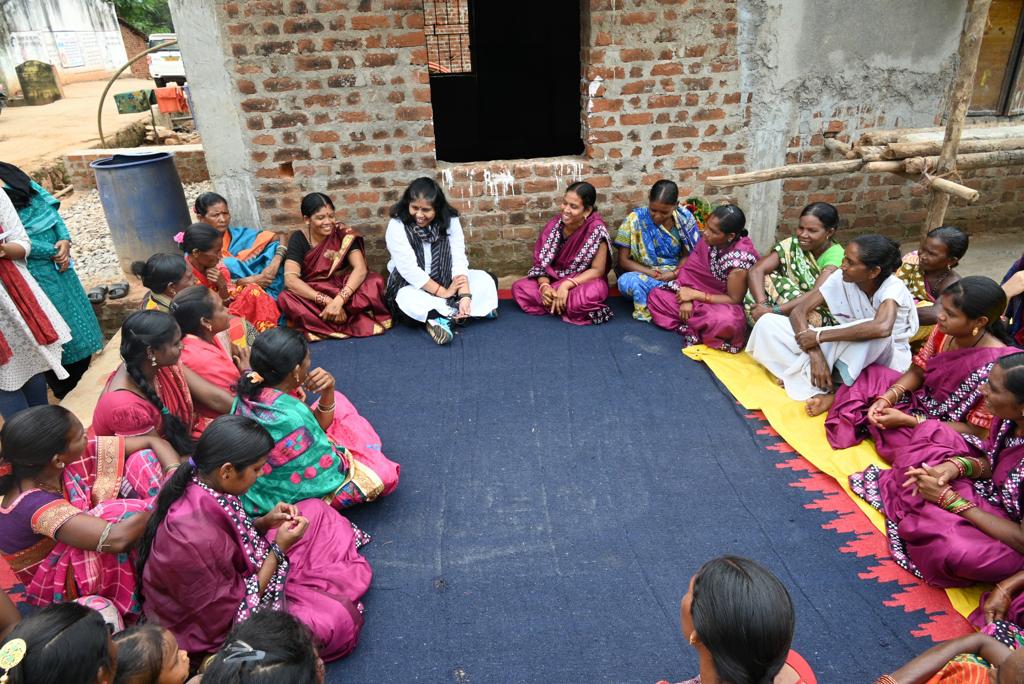
In recent times, officials from the ST & SC Development and Minorities & Backward Classes Welfare department, including the commissioner-cum-secretary, have been regularly visiting tribal-dominated areas as part of the ‘Observe to Act’ (O2A) initiative. This initiative aims to assess the impact of development initiatives undertaken by the department.
Through O2A, officials interact with the local communities, visit livelihood projects, schools, and hostels, and engage with children to understand their welfare, awareness of their entitlements, and overall well-being. This direct engagement has built trust among beneficiaries and enabled officials to ensure the safety and quality of education provided in hostels. Additionally, O2A efforts identify key influencers who play pivotal roles in driving positive change within the communities.
Roopa Roshan Sahoo, commissioner-cum-secretary of the SSD & MBCW Department, encapsulated the government’s commitment to empowering indigenous children and nurturing their aspirations, stating, “We are appointing welfare officers who are playing motivators’ role for these children in hostels and are encouraging them to continue study after the school education. They are counseling them about their future, which helps them dream big and aspire to achieve their goals.”
Efforts to achieve gender equality and empower indigenous communities in Odisha are multi-faceted, spanning education, livelihood, culture, and community engagement. These initiatives are not only improving the lives of indigenous women and girls but also preserving the rich cultural heritage of tribal communities in the face of modern challenges.
Bhubaneswar: From a proposed international airport to the restoration of historic religious sites, Odisha Chief…
Bhubaneswar, October 12: Students across Odisha have showcased their ideas for a developed India through…
Bhubaneswar: More than 170 students and vocational lecturers from Government Vocational Higher Secondary Schools across…
Bhubaneswar: East Coast Railway (ECoR) is expanding its technology-driven security network, with plans to increase…
Bhubaneswar: Odisha’s traditional handloom and handicraft heritage took centre stage at Bhubaneswar Times Fashion Week…
Bhubaneswar: With physical tests for the recruitment of Foresters, Forest Guards and Excise Constables set…