Bhubaneswar: Odisha’s heritage extends far beyond its celebrated temples, royal monuments and archaeological remains. It lives in village rituals, sacred caves, folk traditions, manuscripts, wooden images and stories preserved by communities across generations.
This living heritage came into focus through heritage walks organised on Sunday in the Chilika-Barakul region and Dhenkanal, offering participants an opportunity to explore lesser-known cultural and historical sites. While the Dhenkanal Heritage Walk continued its long-running community initiative, the Chilika Heritage Walk (CHW) marked a new effort to explore and interpret the region’s cultural heritage through public participation.
The second edition of the Chilika Heritage Walk was organised by the ODI ART Centre under the leadership of Bisheswar Das and Sushant Kumar Dash.
The walk began near the Maa Narayani Temple, taking participants through a site where religious tradition, history and local memory converge. Although the present structure belongs to a later period, the original shrine is believed to predate the 12th century AD. Some archaeological documentation traces elements of its foundation to as early as the 7th century AD, during the Bhaumakara period.
The temple’s later history is closely associated with the Zamindars and rulers of Khallikote. In the early 18th century, the rulers undertook extensive renovation, transforming the old shrine surrounded by forest into a formal stone temple.
The walk subsequently took participants to Debijhara near Barakul, a scenic reservoir and viewpoint nestled against the foothills of the Eastern Ghats. The combination of hills and water has led local explorers to describe the landscape as a miniature “Second Chilika”.
The event also gave children an opportunity to engage with heritage through creative expression. More than 20 students from Venkateshwar English Medium School, Barakul, along with five students from Khalikote Art College, documented their experiences of the temple and created canvas paintings inspired by Debijhara.
The walk also highlighted the role of institutions such as the ODI ART Centre in keeping folk and tribal traditions alive. Such traditions, participants noted, are not merely museum exhibits but continue to thrive through artists, craftspeople, performers and ritual communities.
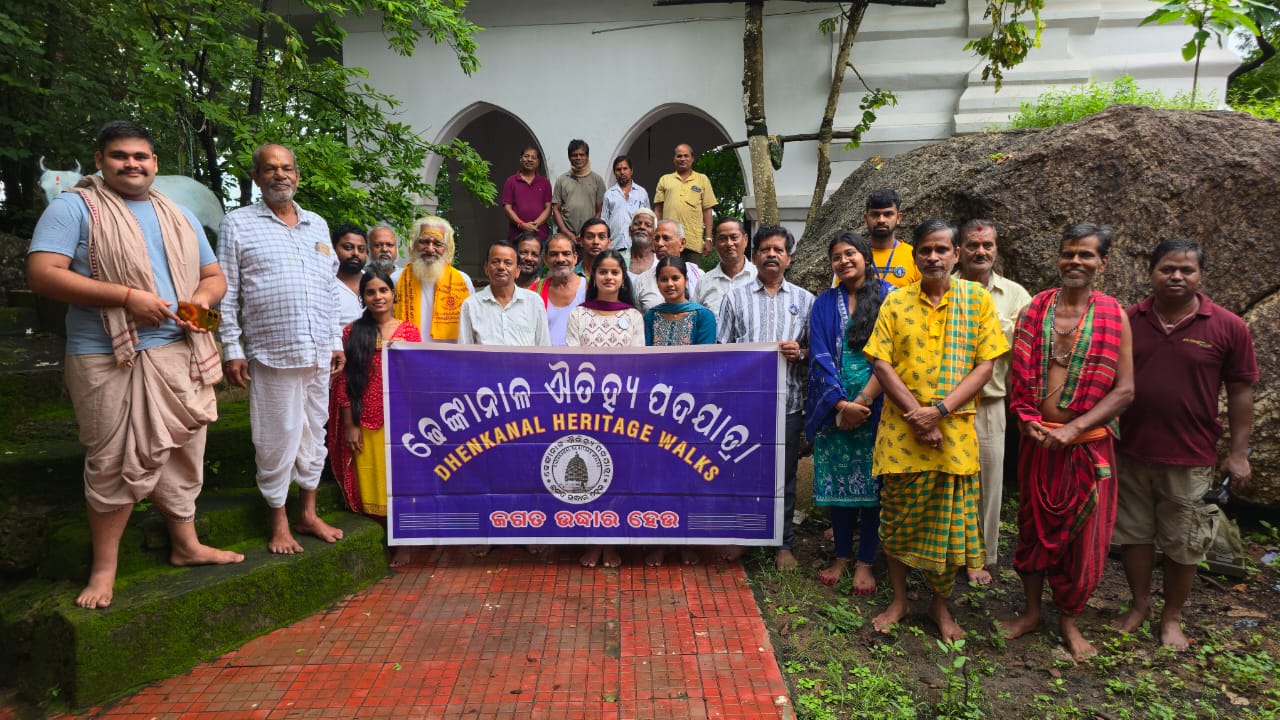
Meanwhile, the 40th Dhenkanal Heritage Walk (DHW) was organised at the historic Gumpha Jagannath Temple, also known as Harihara Ashram, in Gandia block.
Located amid a tranquil natural landscape, the Ashram is regarded by its monks and followers as an important centre of Jagannatha culture and pilgrimage, with a tradition believed to span around two centuries.
Participants explored the Jagannatha and Shiva temples, the cave or gumpha and the surrounding natural landscape. The local trust has been playing an important role in preserving the site and conducting its traditional rituals, including the annual Rath Yatra.
According to local accounts, around two centuries ago, a saint installed the Chaturdha deities inside a cave at Duburi and worshipped them there. Following his death, local devotees continued the tradition and eventually constructed a temple at the site.
The hill is dotted with several caves, where idols of different deities have been installed. A Shiva temple has also been constructed within the complex.
The heritage walk was organised under the leadership of DHW convenor Suresh Prasad Mishra, with local residents and custodians playing an important role in sharing the history and traditions associated with the site.
The two walks, though held in geographically different parts of the state, highlighted the diverse ways in which Odisha’s heritage survives.
At Dhenkanal, heritage continues through Jagannatha traditions, rituals, caves and community worship, while around Chilika and Barakul, it emerges through the intersection of ecology, folk art, temple traditions, sacred geography and natural landscapes.
Heritage walks provide an opportunity to look beyond conventional monuments and discover the stories embedded in everyday cultural landscapes. They also give local custodians a platform to share knowledge and oral histories that may not always find a place in official records.
With plans to expand heritage walks to more parts of Odisha, such initiatives could help bring lesser-known cultural sites into public attention while encouraging younger generations to reconnect with the traditions, landscapes and histories that surround them.
Bhubaneswar: Braj Mohan Ram on Sunday took oath as the new Governor of Odisha at…
Bhubaneswar: Recognising their gold medal-winning performances at the 2026 Asian Games in Japan, Odisha Chief…
Bhubaneswar: Two school-going sisters from Odisha have used a multiplication table to deliver a social…
Bhubaneswar: The Satwalipi Committee on Mahaprabhu Lingaraj Temple has submitted its third interim report to…
Bhubaneswar: Odisha will organise a state-level summit to finalise priorities and accelerate the implementation of…
Bhubaneswar: The Housing and Urban Development Department has asked Urban Local Bodies (ULBs) across Odisha…