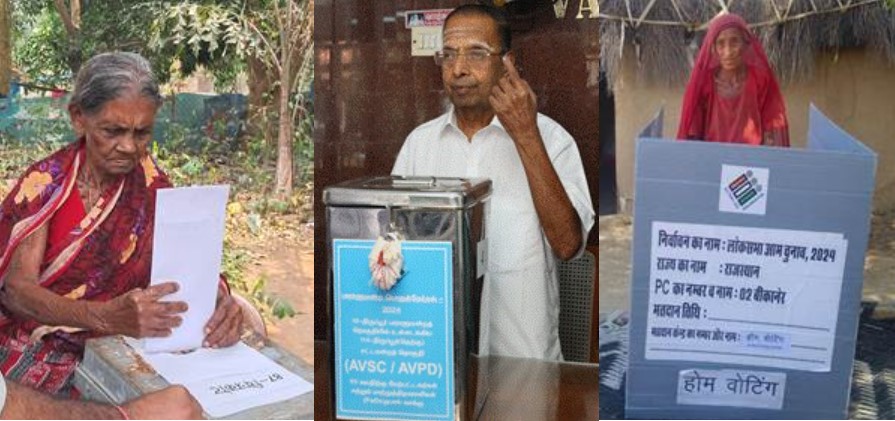
New Delhi: In an unprecedented move, the Election Commission of India (ECI) has introduced home voting for the elderly and Persons with Disabilities (PwDs) in the 2024 Lok Sabha elections, marking a significant stride towards inclusivity and accessibility in the electoral process. This initiative, a first in the history of Lok Sabha elections, aims to ensure that every eligible citizen can exercise their right to vote, irrespective of physical limitations or age.
Voters aged 85 and above, as well as PwDs with a benchmark disability of 40%, have the option to avail of the home voting facility. Already, voters in this category have commenced casting their votes for phases I and II of polling across the country. With over 81 lakh voters aged 85 and above and more than 90 lakh registered PwD voters nationwide, this initiative addresses a substantial segment of the electorate, fostering greater democratic participation.
Chief Election Commissioner Rajiv Kumar, along with Election Commissioners Gyanesh Kumar and Dr. Sukhbir Singh Sandhu, emphasized that providing home voting facilities demonstrates the Commission’s commitment to the welfare and dignity of elderly and PwD voters. The initiative is expected to set an example for societal inclusivity and care beyond the electoral realm.
Reports from various states highlight the impact of home voting on voters’ experiences. In Churu, Rajasthan, eight PwD voters from a single family exercised their franchise, showcasing the strength of India’s electoral democracy. Similarly, in Chhattisgarh, voters like 87-year-old Indumati Pandey and 86-year-old Sonmati Baghel in Bastar and Sukma districts utilized the postal ballot at home, expressing gratitude to the Election Commission for the opportunity. In Maharashtra, ECI teams traveled significant distances to provide home voting facilities to elderly voters in remote areas.
The testimonials from voters like BR Mishra from Jaysingh Nagar, Madhya Pradesh, reflect the appreciation and joy experienced by those who have availed of home voting facilities. Mishra’s words of praise for the Election Commission’s efforts underscore the transformative potential of inclusive electoral practices.
The implementation of home voting has posed logistical challenges, particularly in identifying eligible voters within the vast electoral roll of the country. Yet, the positive impact of this initiative on democratic participation and societal inclusivity cannot be overstated. As home voting continues to unfold across the nation, it serves as a beacon of inclusivity, empathy, and empowerment within India’s democratic fabric.
Bhubaneswar: The Housing and Urban Development Department has asked Urban Local Bodies (ULBs) across Odisha…
Bhubaneswar: From exploring ancient temples and the story of Odisha’s capital city to discovering local…
Bhubaneswar: Odisha will prepare a dedicated lightning safety action plan for 2027 and a roadmap…
Bhubaneswar: The Women and Child Development (WCD) Department of the Odisha government has signed a…
Baripada: Wildlife enthusiasts and nature lovers can return to Similipal Tiger Reserve in Odisha’s Mayurbhanj…
Bhubaneswar: Applicants who secure flats under the Bhubaneswar Development Authority’s (BDA) Ekamra Residency housing project…
