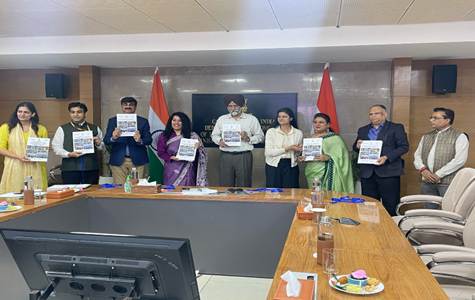
New Delhi: The Department for Promotion of Industry and Internal Trade (DPIIT), under the Ministry of Commerce and Industry, today unveiled a landmark study titled “Enabling Women’s Participation in India’s Logistics Sector.” The study, prepared in collaboration with Deutsche Gesellschaft für Internationale Zusammenarbeit (GIZ) GmbH under the Indo-German Development Cooperation project “Climate Friendly Green Freight Transport in India (Green Freight Project),” explores strategies to increase women’s inclusion in the rapidly growing logistics industry.
Releasing the study, DPIIT Secretary Amardeep Singh Bhatia underscored its relevance to India’s National Logistics Policy and the broader vision of women-led development. He emphasized that as India moves towards its goal of becoming a developed nation, integrating women into high-growth industries like logistics is not only a step towards equity but also an economic imperative.
“As we move towards Viksit Bharat under the leadership of the Prime Minister, one key factor driving the country forward will be women-led development. Ensuring greater participation of women in sectors like logistics is essential not just for social equity but for India’s economic growth,” he stated.
Bhatia also stressed the importance of education and skill development in changing societal perceptions. “Women have the same capabilities as men, but what is required is a shift in mindset. The logistics sector must adapt to the needs of women by providing the necessary infrastructure and a more inclusive workplace ecosystem,” he added.
The study provides a comprehensive assessment of the current status of women’s participation in the logistics sector, identifies key challenges, and proposes policy recommendations to boost gender diversity. With the logistics industry projected to reach $380 billion by 2025, increasing women’s representation in the workforce is seen as crucial for sustained growth.
The report highlights supply-side barriers such as gender disparities in education and skill training and demand-side obstacles including workplace culture and infrastructure limitations. It advocates for a three-tiered intervention strategy at the ecosystem, industry, and firm levels to drive meaningful change.
Bhubaneswar: Odisha has received the prestigious ‘Wind India 2026: Leadership in Wind Energy De-risking’ award…
Bhubaneswar: From a proposed international airport to the restoration of historic religious sites, Odisha Chief…
Bhubaneswar, October 12: Students across Odisha have showcased their ideas for a developed India through…
Bhubaneswar: More than 170 students and vocational lecturers from Government Vocational Higher Secondary Schools across…
Bhubaneswar: East Coast Railway (ECoR) is expanding its technology-driven security network, with plans to increase…
Bhubaneswar: Odisha’s traditional handloom and handicraft heritage took centre stage at Bhubaneswar Times Fashion Week…