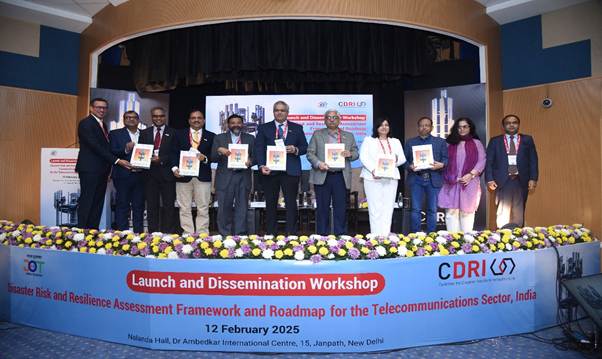
New Delhi: In a major step towards enhancing disaster preparedness and telecom resilience, the Department of Telecommunications (DoT), in collaboration with the Coalition for Disaster Resilient Infrastructure (CDRI), released a comprehensive report on Disaster Risk and Resilience Assessment Framework (DRRAF). The framework, launched today, provides a roadmap for strengthening India’s telecom infrastructure against natural calamities, ensuring uninterrupted connectivity before, during, and after disasters.
The study, conducted across five states—Assam, Odisha, Tamil Nadu, Uttarakhand, and Gujarat, assessed disaster risks and resilience strategies for the telecom sector. DoT coordinated with State Governments, Telecom Service Providers (TSPs), and Infrastructure Providers to facilitate data collection for this initiative.
In his message at the inaugural session, Dr. Neeraj Mittal, Secretary (Telecom) & Chairman, Digital Communications Commission (DCC), emphasized that telecom resilience is a national priority. He reaffirmed DoT’s commitment to ensuring seamless connectivity during disasters, aligning with the UN’s ‘Early Warning for All by 2027’ initiative. Dr. Mittal called for collaborative action from government agencies, telecom operators, and disaster management bodies to fortify India’s telecom infrastructure.
Sharing his experience with disaster response, Manish Sinha, Member (Finance), DoT, underscored the critical role of telecom networks in post-disaster recovery. He noted that the study’s findings provide a structured approach to minimizing service disruptions, reinforcing telecom infrastructure, and enhancing emergency response mechanisms.
Sanjay Agrawal, DDG (Disaster Management), DoT, highlighted the invaluable support from all Licensed Service Areas (LSAs), TSPs, Infrastructure Providers, and Industry Associations such as DIPA, COAI, and IBF, as well as government agencies like the NDMA and SDMAs. He emphasized that real-world experiences and technical insights have shaped the study’s recommendations, ensuring practical implementation.
Speaking on the economic and strategic significance of resilient telecom networks, Amit Prothi, Director General of CDRI, pointed out that telecom contributes significantly to India’s GDP. He emphasized that resilient telecom networks are essential for economic growth, disaster response, and seamless connectivity. He further stated that the study provides actionable insights, scalable models, and global best practices to build disaster-resistant telecom services.
DoT has been actively implementing several strategic initiatives to enhance disaster resilience in the telecom sector, including:
- Real-time coordination between LSAs, state governments, and telecom operators for rapid disaster response.
- Nationwide deployment of an indigenous Cell Broadcast System for emergency alerts.
- Development of Public Protection and Disaster Relief (PPDR) networks in collaboration with the Ministry of Home Affairs.
- Strengthening regulatory measures for quick restoration of telecom services.
- Promotion of satellite-based communication and High Altitude Platform Systems (HAPS) to ensure connectivity in disaster-prone areas.
The study conducted a multi-hazard risk assessment covering 0.77 million telecom towers to evaluate risks from floods, cyclones, earthquakes, and other disasters. A Disaster Risk and Resilience Index was developed to assess the vulnerability of telecom infrastructure based on disaster intensity, frequency, and impact.
The report outlines several strategic recommendations aimed at fortifying the telecom sector against disasters, including:
- Technical Upgrades – Enhancing infrastructure planning and design to withstand extreme weather events.
- Data-Driven Risk Management – Developing a multi-hazard information repository for real-time risk assessment.
- Policy Reforms – Integrating disaster resilience into telecom regulations.
- Financial Safeguards – Implementing risk-sharing instruments to protect telecom operators from financial losses.
- Cross-Sectoral Collaboration – Establishing a coordinated framework for disaster response across government, telecom, and disaster management agencies.
- Ensuring Last-Mile Connectivity – Expanding telecom access in remote areas to maintain uninterrupted emergency communication.
- Leveraging AI and Digital Tools – Deploying AI-driven solutions for monitoring telecom resilience.
- Capacity Building – Upskilling telecom personnel to enhance disaster preparedness.
- Advanced Monitoring Systems – Implementing real-time tracking mechanisms to improve service restoration.
With DoT’s leadership and multi-stakeholder collaboration, the adoption of this framework will empower India’s telecom sector to effectively anticipate, respond to, and recover from disasters. The recommendations will ensure that telecom networks remain operational in times of crisis, supporting emergency services and economic stability.
CDRI aims to mainstream disaster resilience principles into telecom policy and planning, encouraging global knowledge-sharing and coordination. The release of this risk and resilience framework marks a significant step in securing India’s telecom infrastructure and ensuring uninterrupted connectivity during emergencies.