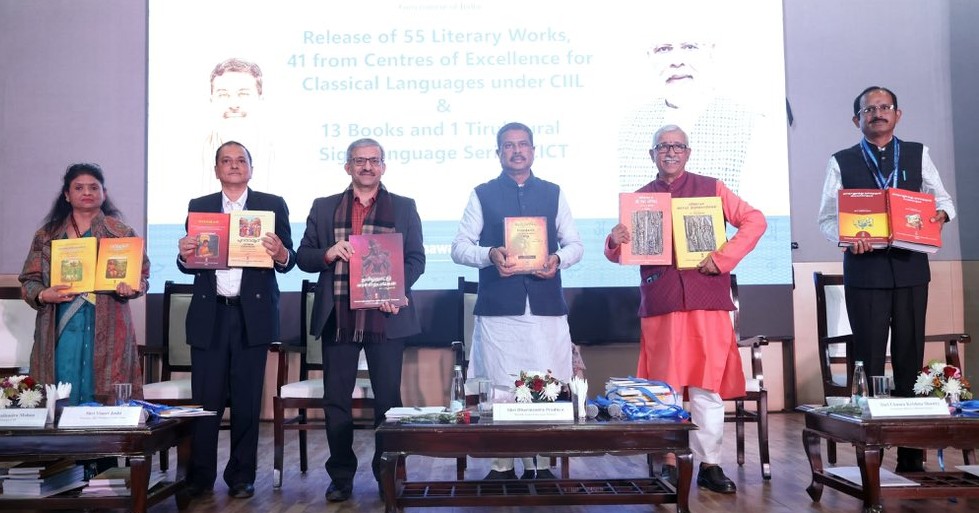
New Delhi: Union Minister for Education Dharmendra Pradhan on Tuesday released 55 literary works in classical Indian languages at a function held in New Delhi, reaffirming the Government of India’s commitment to preserving and promoting the country’s rich linguistic and literary heritage.
The releases include 41 books developed by the Centres of Excellence for Classical Languages under the Central Institute of Indian Languages (CIIL), along with 13 books and a Tirukkural Sign Language series brought out by the Central Institute of Classical Tamil (CICT). The publications span important scholarly works in Kannada, Telugu, Malayalam, Odia and Tamil, and also feature an interpretation of the Tirukkural in Indian Sign Language, marking a significant step towards inclusive access to classical knowledge.
Speaking on the occasion, Pradhan said that under the leadership of Prime Minister Narendra Modi, the government has taken sustained efforts to strengthen and promote Indian languages—ranging from expanding the scheduled list of languages to translating classical texts and encouraging education in Indian languages. He noted that Indian languages have withstood the test of time despite historical attempts to undermine them.
Describing India as the mother of democracy and a nation of immense linguistic diversity, the Union Minister stressed that it is society’s collective responsibility to preserve the country’s historical, cultural and literary wealth and pass it on to future generations. Languages, he said, act as a unifying force, recalling the Prime Minister’s view that all Indian languages are national languages.
Pradhan highlighted that the inclusion of the Tirukkural in Indian Sign Language reflects the vision of an inclusive India, ensuring access to knowledge for all sections of society. He termed the initiative a valuable contribution to India’s intellectual and literary traditions.
Referring to the National Education Policy (NEP) 2020, the Minister said it advances the vision of education in Indian languages and reinforces India’s ethos of unity in diversity. Contrasting it with the colonial-era Macaulay mindset, he observed that Indian civilisation has always viewed languages as bridges for dialogue, harmony and cultural exchange.
He congratulated the Bharatiya Bhasha Samiti on Indian Languages, the Centres of Excellence, CIIL and CICT for their dedicated efforts in promoting Indian languages and classical knowledge systems.
The event was attended by Vineet Joshi, Secretary (Higher Education), Ministry of Education; Chamu Krishna Shastry, Chairman, Bharatiya Bhasha Samiti; Prof. Shailendra Mohan, Director, CIIL; Prof. R. Chandrasekaran, Director, CICT; Manmohan Kaur, Advisor (Cost), and other senior officials of the Ministry of Education.
Bhubaneswar: With physical tests for the recruitment of Foresters, Forest Guards and Excise Constables set…
Bhubaneswar: Adapting government communication to the rapidly evolving digital and artificial intelligence (AI) landscape while…
Bhubaneswar: Olympian hockey player and East Coast Railway (ECoR) Sports Officer Amit Rohidas was felicitated…
Bhubaneswar: In a major push to expand egg production and attract investment in the poultry…
Bhubaneswar: The Information and Public Relations (I&PR) Department organised a one-day orientation programme on “Emerging…
Bhubaneswar: Odisha’s disaster management model continues to draw interest from students pursuing disaster management studies,…