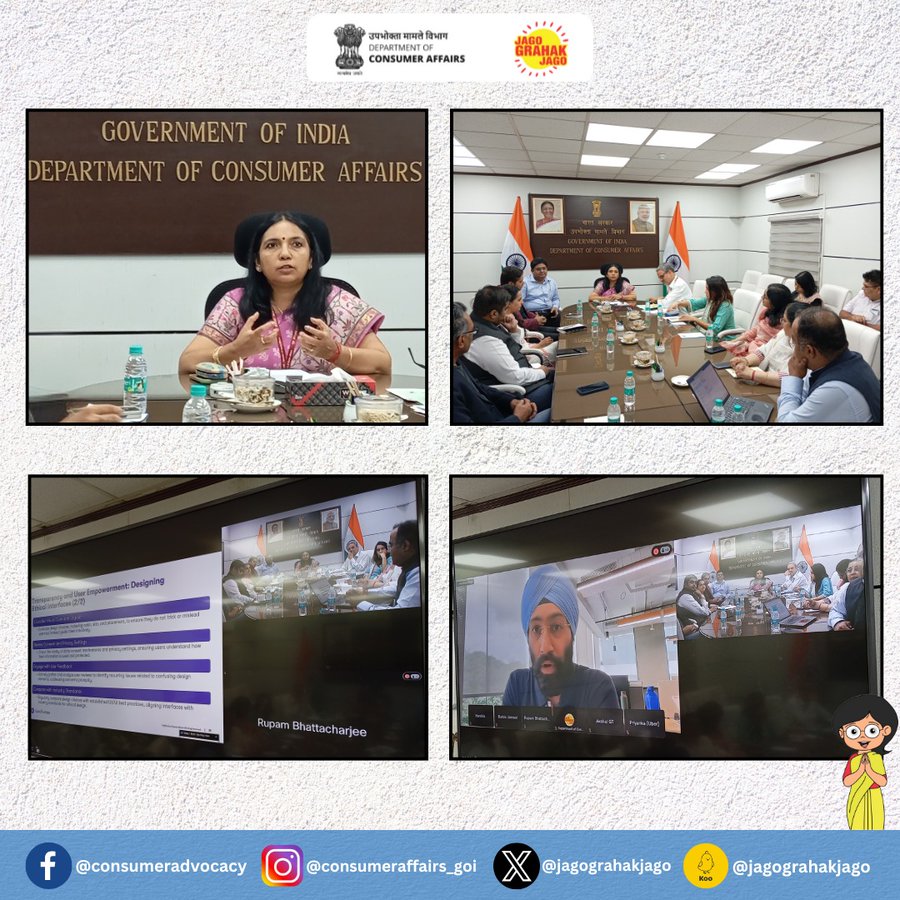
New Delhi: The Department of Consumer Affairs held an interactive session today to discuss the implementation of guidelines aimed at tackling the issue of dark patterns in e-commerce. The event focused on deceptive design practices on online platforms and explored effective strategies for their regulation.
Nidhi Khare, Secretary of the Department of Consumer Affairs, Government of India, warned e-commerce platforms against employing dark patterns, emphasizing that such practices constitute “unfair trade practices” and infringe upon consumer rights. Khare suggested various measures for e-commerce platforms to avoid deceptive designs, including leveraging consumer feedback, enhancing user satisfaction, monitoring repeat user rates, using built-in app features to identify non-compliant patterns, and conducting self-audits.
The Department had previously issued the Guidelines for Prevention and Regulation of Dark Patterns 2023 in November 2023, outlining 13 specific dark patterns: False Urgency, Basket Sneaking, Confirm Shaming, Forced Action, Subscription Trap, Interface Interference, Bait and Switch, Drip Pricing, Disguised Advertisements, Nagging, Trick Wording, SaaS Billing, and Rogue Malware.
A notable initiative, the Dark Patterns Buster Hackathon (DPBH-2023), organized in collaboration with IIT BHU, concluded on March 15, 2024. Launched on October 26, 2023, the Hackathon aimed to develop innovative app or software-based solutions to detect and combat dark patterns in e-commerce. The DPBH-2023 attracted participants from over 150 colleges nationwide.
Today’s session, held in a hybrid format, included stakeholders from IIT BHU and industry representatives from organizations such as the All India Gaming Federation, Zomato, Easemytrip, Urban Company, Uber, and CRED. A highlight of the event was a demonstrative video by a team of IIT BHU students showcasing their extension tool, which uses Large Language Models (LLMs), Generative AI, and other advanced technologies to identify and alert users to dark patterns on e-commerce platforms.
The session concluded with widespread appreciation for the collaborative efforts of the Department and IIT BHU. Industry stakeholders pledged their support by offering assistance and access to their datasets, aiming to distinguish deceptive designs from legitimate ones on their platforms.
Bhubaneswar: The inaugural edition of the National Indoor Athletics Championships is set to begin on…
Bhubaneswar: In a bid to enhance urban safety and emergency readiness, the Housing & Urban…
Bhubaneswar: The Kala Bhoomi museum celebrated its 8th Foundation Day on Sunday at Gandamunda with…
Bhubaneswar: Amid growing concerns over safety in healthcare facilities, Health & Family Welfare Minister Dr.…
Bhubaneswar: Marking the World Water Day celebrations, Chief Minister Mohan Charan Majhi on Sunday inaugurated…
Bhubaneswar: The Higher Education Department, Government of Odisha has released the admission schedule for two-year…