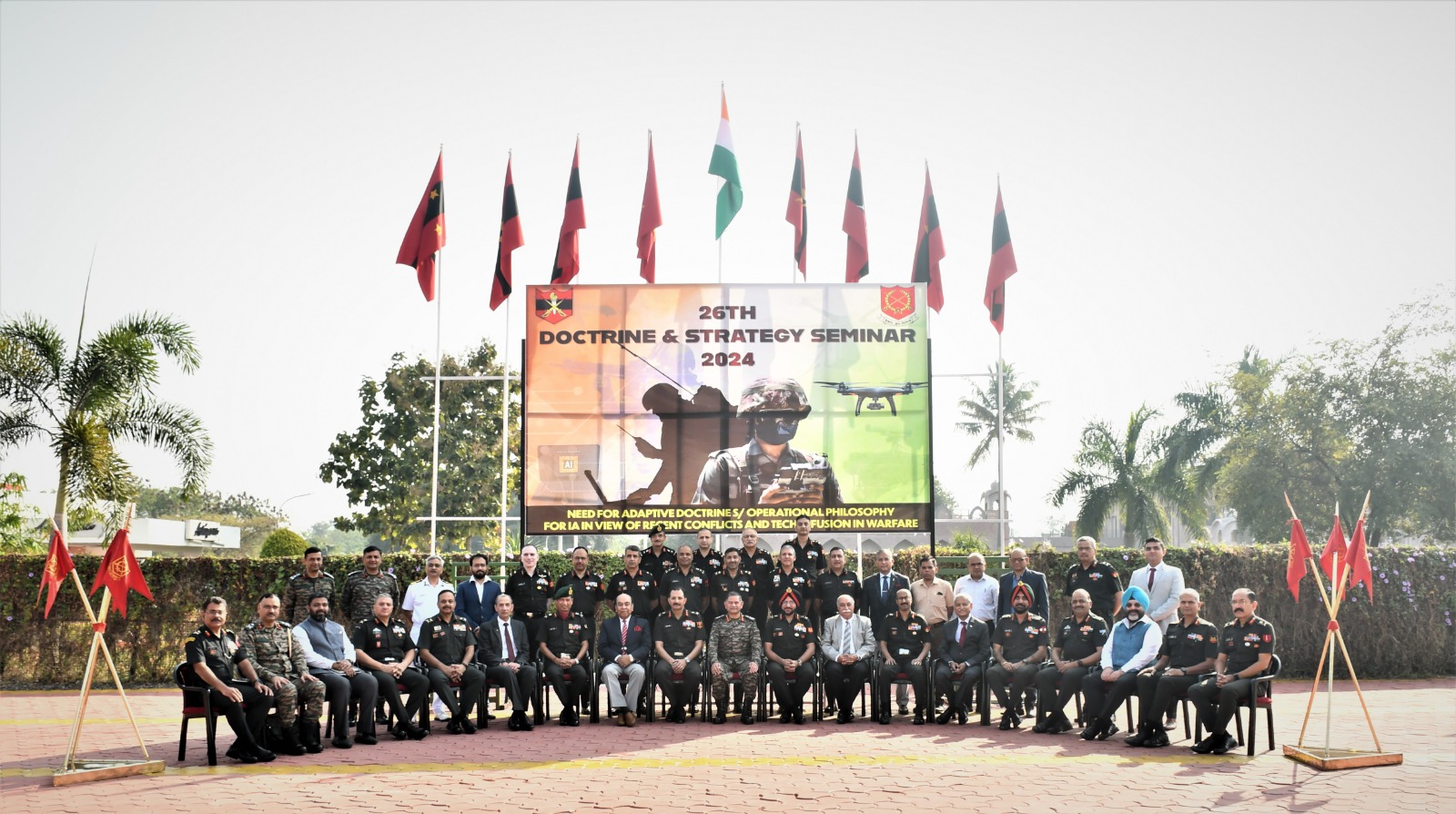
Mhow: Chief of the Army Staff (COAS) General Upendra Dwivedi addressed participants at the 26th Doctrine and Strategy Seminar (DSS) held at the Army War College in Mhow today. The two-day seminar, organized under the theme ‘Need for Adaptive Doctrines/Operational Philosophy for Indian Army in View of Recent Conflicts and Technology Infusion in Warfare,’ focused on examining the evolving landscape of warfare and the need for transformation in India’s military strategies.
The seminar, which convened experts from the realms of geo-strategic and geo-political affairs, defence sector, and armed forces, aimed to critically analyze the validity of existing doctrines, operational strategies, and tactics in light of recent conflicts and the integration of cutting-edge technologies into warfare. It sought to recommend necessary changes to better equip the Indian Army for future challenges.
In his address, General Dwivedi underscored the critical need for adaptation and transformation in military doctrines to align with the realities of modern warfare. He emphasized the importance of infusing niche technologies into the military’s operational philosophies to meet emerging threats effectively. The COAS noted that modern conflicts often extend beyond traditional battlefields, with political objectives pursued through both military and non-military means.
General Dwivedi introduced the concept of the 5Cs – Competition, Crisis, Confrontation, Conflict, and Combat – as the new continuum of warfare. He explained that contemporary warfare now blends statecraft and diplomacy with kinetic (traditional) and non-kinetic (new-age) actions, including disinformation campaigns, cyber-attacks, and the use of artificial intelligence and autonomous systems. While emphasizing the evolving nature of warfare, he also reaffirmed the relevance of older military strategies.
The seminar was divided into three key themes, each examining crucial aspects of modern warfare:
General Dwivedi also drew lessons from the ongoing Russia-Ukraine war, highlighting key takeaways for the Indian Army. He stressed the importance of combined arms operations, leveraging asymmetric tactics, and enhancing civil-military integration. These lessons, he explained, align with the broader framework of DIME (Diplomacy, Information, Military, and Economic), which integrates statecraft with military strategies.
Furthermore, the COAS spoke about the importance of adapting to multi-domain warfare, particularly with regards to hybrid threats from both state and non-state actors. He pointed out the ongoing Decade of Transformation (2023-2032) as a pivotal step in integrating innovative strategies to strengthen India’s military capabilities.
General Dwivedi concluded his address by emphasizing the importance of developing adaptive military doctrines that integrate emerging technologies such as AI, cyber warfare, and precision warfare. He highlighted the need for flexible doctrines that allow for rapid decision-making and decentralized leadership, particularly at the tactical level. He also called for greater jointness and interoperability between different branches of the military and allied nations.
The COAS stressed the importance of fostering strong leadership capable of guiding the Indian Army through the evolving challenges of modern warfare. He advocated for reducing doctrinal rigidity to enhance agility, ensuring that the army is equipped to respond to rapidly changing battlefield dynamics.
In his closing remarks, General Dwivedi reiterated the need for dynamic threat assessments, realistic training, and wargaming, ensuring that the Indian Army remains at the forefront of modern warfare strategies. The development of adaptive, technology-driven doctrines will be key to preparing for future conflicts and safeguarding national security in the face of evolving challenges.
Bhubaneswar: In view of the approaching cyclonic storm “Arnab”, four passenger train services have been…
Gajapati: The Gajapati district administration has evacuated 10,200 people from 147 cyclone-vulnerable areas and stepped…
Bhubaneswar: All schools, colleges and Anganwadi centres in Kendrapara and Kandhamal districts will remain closed…
Bhubaneswar: In view of the anticipated cyclonic conditions due to Cyclonic Storm ‘Arnab’, 22 express…
Rayagada: Odisha Deputy Chief Minister Pravati Parida on Wednesday reviewed the preparedness of Rayagada district…
Bhubaneswar: With Cyclone Arnab posing a threat to parts of Odisha, the state government has…