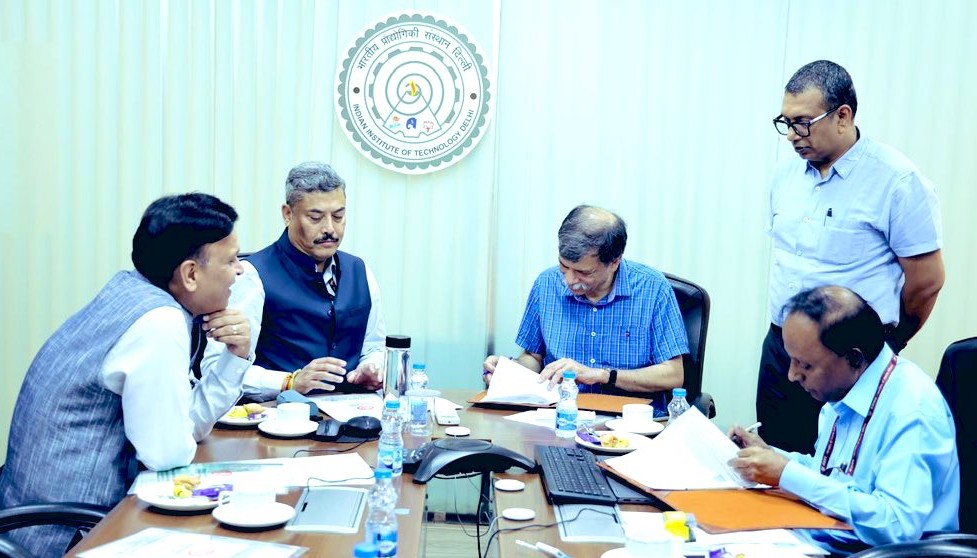
New Delhi: To enhance trade facilitation and strengthening scientific capabilities in customs operations, the Central Revenues Control Laboratory (CRCL), functioning under the Central Board of Indirect Taxes and Customs (CBIC), Department of Revenue, Ministry of Finance, signed a Memorandum of Understanding (MoU) with the Indian Institute of Technology (IIT) Delhi. This collaboration is aimed at advancing research and development, innovation, and regulatory efficiency to support India’s growing trade ecosystem.
The MoU was signed by Prof. Rangan Banerjee, Director of IIT Delhi, and Shri V. Suresh, Director of CRCL, in the presence of Shri Surjit Bhujabal, Special Secretary and Member (Customs), CBIC. The initiative underscores a shared vision to make India a globally trusted destination for customs compliance and trade facilitation by integrating advanced science with administrative processes.
This partnership will enable CRCL to tap into IIT Delhi’s state-of-the-art R&D infrastructure, allowing modernization of analytical systems and introducing trace-level detection and sophisticated instrumentation across the CRCL laboratory network. The collaboration is also expected to promote the development of rapid testing protocols and automated screening methods that will significantly reduce cargo clearance times and improve the ease of doing business.
The MoU outlines a roadmap for conducting joint research in customs-related regulatory science, facilitating technology transfer, and deploying advanced analytical techniques in CRCL and its 12 regional laboratories. It will also lead to the creation of standardized operating procedures, analytical databases, and the development of reference materials. Importantly, IIT Delhi faculty will provide academic mentorship to CRCL scientists to build scientific capabilities in emerging areas such as nanotechnology, materials science, and forensic chemistry.
The agreement supports the Government of India’s ‘Make in India’ initiative by offering scientific validation and faster testing for Indian-manufactured goods, fostering industry confidence and enabling efficient customs procedures. It also aligns India’s customs laboratory practices with global standards set by the World Customs Organization (WCO), strengthening the country’s global standing in trade compliance.
A significant outcome of this collaboration will be the establishment of Centres of Excellence in key domains such as narcotics analysis, environmental monitoring, and quality assurance—critical to national and international regulatory goals.
CRCL, headquartered in New Delhi, functions as the apex scientific body under CBIC and supervises a network of 12 revenue laboratories across the country. These laboratories play a crucial role in customs and GST enforcement by conducting chemical analyses to ensure accurate duty assessments and adherence to tax laws. All laboratories are accredited under ISO/IEC 17025:2017, with several holding additional accreditations for forensic, food safety, and environmental testing.
Bhubaneswar: Responding to mounting criticism and political consensus, the Odisha government has begun the process…
Bhubaneswar: The inaugural edition of the National Indoor Athletics Championships concluded on a high note…
Bhubaneswar: The Higher Education Department, Government of Odisha has announced that the Common PG Entrance…
Bhubaneswar: The Government of Odisha has nearly concluded paddy procurement for the 2025–26 Kharif season,…
Bhubaneswar: Strengthening its efforts to stabilise farm incomes and streamline agricultural marketing, the Odisha Rural…
Bhubaneswar: With a growing focus on sustainable agriculture and income diversification, the Agricultural Promotion and…
