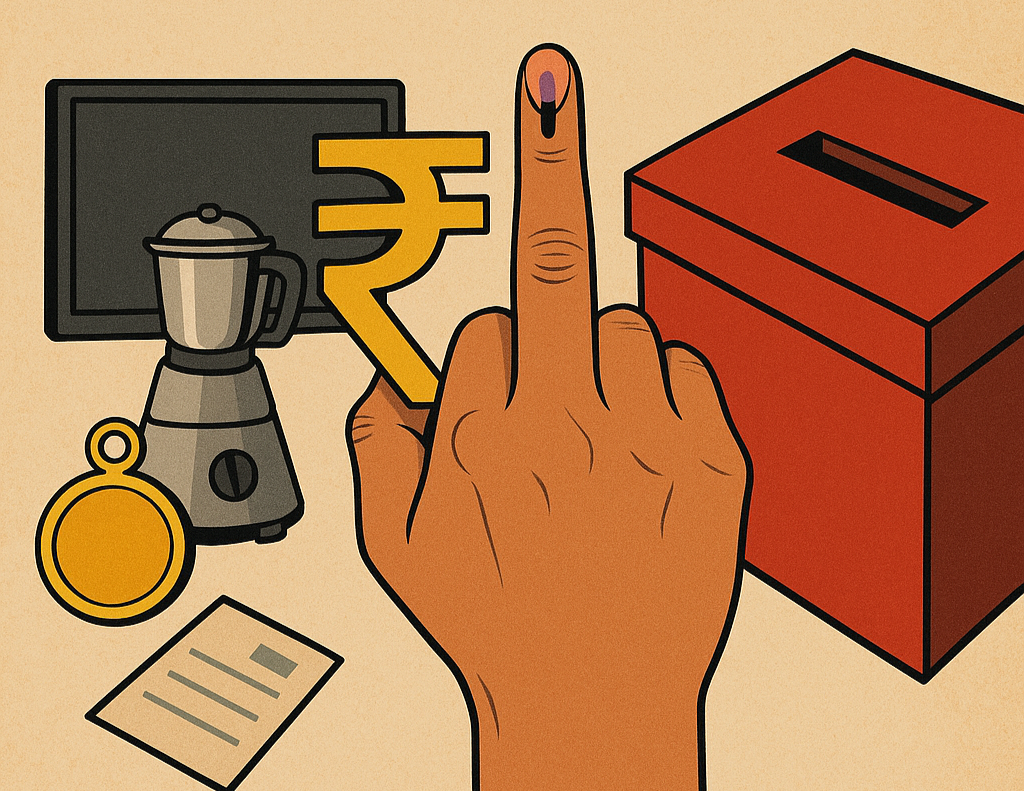
Elections in India increasingly revolve around ideology, leadership, and material promises. Having worked closely on political campaigns in several states and observed voter behavior firsthand, I’ve seen how the line between structured welfare and outright giveaways has blurred. From Tamil Nadu to Delhi, what is often framed as empowerment raises a difficult question: where does welfare end and vote-buying begin?
Tamil Nadu’s welfare legacy began with the 1967 elections, when the DMK promised subsidized rice at ₹1 for 4.5 kg, a bold, anti-poverty measure rooted in targeting. But over the years, I’ve witnessed how that intent slowly gave way to unconditional handouts: TVs, mixer grinders, and gold coins for marriage. These schemes often lack targeting or institutional oversight. Pongal gifts, for example, have morphed into an annual loyalty test. In field conversations, I’ve heard voters speculate that ahead of 2026, the DMK may offer ₹2,500–₹3,000 per ration cardholder. One voter told me, half-joking, “This is our bonus, not a bribe.” That stuck with me.
This culture of competitive populism, measured by what is distributed, not achieved, has spread across states. Bihar offers cycles and electricity grants; West Bengal hands out direct cash transfers. While some schemes tackle real deprivation, many function as short-term fixes without long-term vision or evaluation. Welfare, in many cases, has become a transactional tool for elections.
Even the BJP, which once criticized “Revadi Culture,” mirrored it. In Delhi, it responded to AAP’s free electricity and water promises with similar offers. Based on my work during the 2025 Delhi campaign, I can say this shift wasn’t ideological—it was tactical. Without large-scale job creation or structural reforms, cash transfers become the easiest way to retain public support.
The 2024 Andhra results revealed something interesting. Despite YSRCP’s strong track record of DBTs—something I witnessed closely while working on the campaign—voters weren’t dismissing welfare. They were simply more drawn to the TDP’s counter-offer: higher transfers, wider schemes, and sharper messaging. The loss wasn’t about fatigue; it was about comparison. Entitlements have become the baseline. Voters now choose between versions.
A similar trend unfolded across multiple states with direct cash transfer schemes targeted at women voters. In Jharkhand, the JMM launched the Guruji Mahila Samman Yojana, offering ₹1,000 per month. The BJP responded with Gogo Didi Yojana, promising ₹2,100 in its manifesto. Hemant Soren countered by increasing his promise to ₹2,500. In Maharashtra, the NDA introduced the Ladki Behan Yojana, offering monthly assistance before elections. In Madhya Pradesh, the BJP’s Ladli Behna Yojana became its re-election centrepiece—initially ₹1,000/month, later increased to ₹1,250 with a ₹3,000 goal in the manifesto.
This pattern repeated in Delhi. AAP announced the Mahila Samman Yojana, promising ₹2,100/month to low-income women. The BJP countered with a more aggressive Mahila Samridhi Yojana, offering ₹2,500. These tit-for-tat schemes show how DBTs have become electoral currency, not as empowerment, but as tools of one-upmanship.
This is not a critique of welfare. In a country battling inequality, unemployment, and inflation, state support is vital. But untargeted or duplicative handouts burden public finances, weaken institutions, and reduce citizens to passive recipients.
In 2022, the Supreme Court, responding to a petition by advocate Ashwini Upadhyay, warned of the dangers of unchecked freebies. It proposed a committee with NITI Aayog, RBI, and Election Commission representatives to assess their fiscal and democratic impact. While enforcement is weak, the debate is maturing.
India already has the tools—Aadhaar, DBT, UPI—for precise targeting. What’s needed now is political courage. The 2024 verdict sends a quiet but firm message: freebies can’t win what performance doesn’t earn. As someone who has campaigned across states with contrasting models, I believe Indian democracy is evolving. The question is no longer “What more can we give?” but “How well can we govern?”
Note: Divakar S is Political Consultant and Public Policy Student at the Takshashila Institution
Bhubaneswar: Two MEMU train services between Gunupur and Cuttack will undergo temporary changes as the…
Bhubaneswar: Odisha has launched the state-level campaign for the Viksit Bharat Youth Leadership Dialogue (VBYLD)-2027,…
Bhubaneswar: Senior IAS officer Dr Brundha D on Wednesday assumed charge as Commissioner-cum-Secretary of the…
Bhubaneswar: Odisha Deputy Chief Minister and Energy Minister Kanak Vardhan Singh Deo has directed Tata…
Abu Dhabi/Bhubaneswar: Odisha is exploring greater trade and business opportunities with the UAE, with a…
Bhubaneswar: Odisha is looking to take its indigenous specialty rice varieties, particularly Kalajeera rice, to…