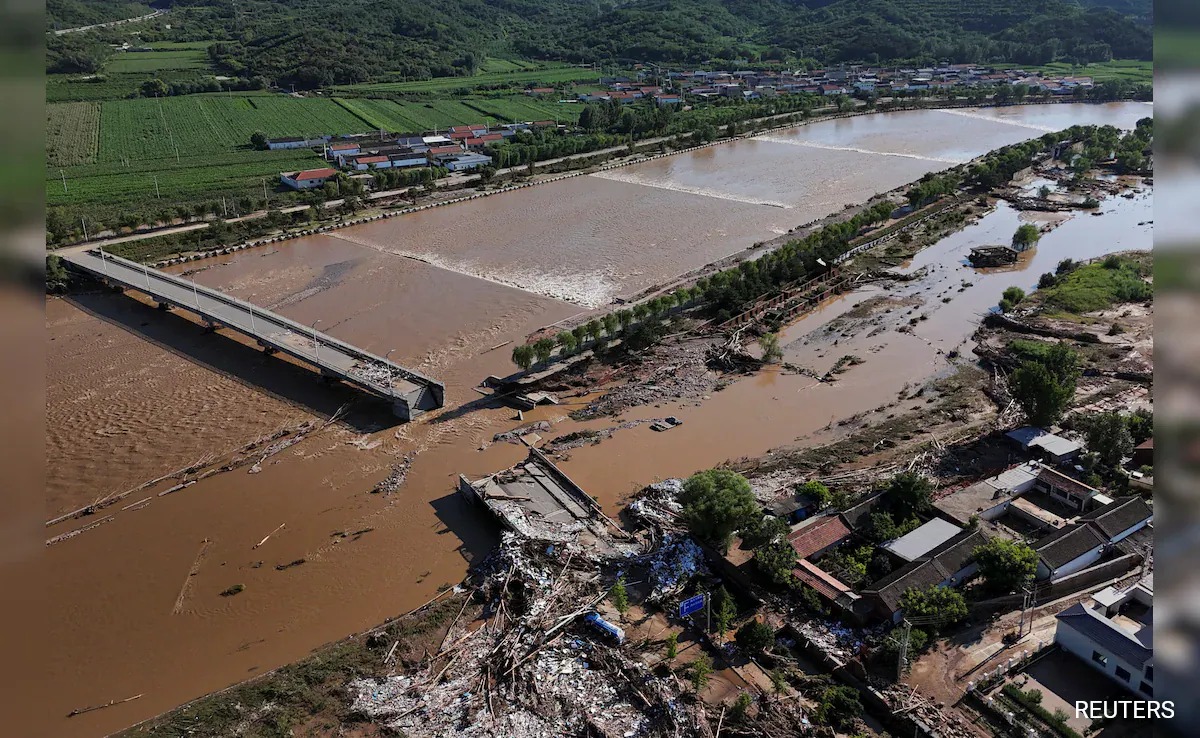
Beijing: The aftermath of Beijing’s recent torrential rainstorms continues to unfold grimly, with officials confirming 44 deaths and nine people still missing. The storms, which triggered widespread flooding and infrastructure collapse, have left a trail of destruction across the capital, especially in northern mountainous districts.
One of the worst-hit locations was an elderly care home in Taishitun town, Miyun District, where 31 residents lost their lives. Four village Party secretaries, key figures in local emergency management, remain unaccounted for, highlighting the severity of the crisis and the challenges faced by first responders.
More than 300,000 residents have been impacted, and nearly 24,000 homes have suffered damage. Reports indicate that over 40 townships and more than 300 villages experienced significant infrastructure losses. Flash floods, intensified by upstream flows, battered the region, prompting urgent evacuations and emergency measures.
Beijing’s largest water body, the Miyun Reservoir, faced enormous strain during the storm. At the height of the inflow, it received enough water in minutes to fill Kunming Lake at the Summer Palace, said Executive Vice Mayor Xia Linmao. In just one week, 910 million cubic metres of water flowed into the reservoir—surpassing the city’s previous record set in 1974. Authorities confirmed that the water level has since stabilised, easing fears of further flooding.
Swift government action followed the deluge. Authorities declared a Level I flood emergency—the highest tier—and launched large-scale rescue and relief operations. Over 104,000 people were evacuated as flash floods swept through rural and mountainous regions. Search operations have rescued more than 5,400 individuals so far.
Rescue teams, comprising 6,830 personnel, were deployed with over 1,300 vehicles and nearly 300 boats. Fire and rescue forces used drones, heavy equipment, and even swimming techniques to reach stranded residents. More than 1,800 people were directly rescued by these units, and essential supplies weighing around 56 tonnes were distributed to affected areas.
Efforts to restore basic services are also progressing. Out of 424 disrupted rural roads, 364 have already reopened, and all administrative villages now have access to emergency water. Electricity has been restored to 105 of the 213 villages that experienced outages.
Beijing officials are now focusing on long-term recovery. Damaged homes are being repaired, and measures are in place to ensure that displaced residents can return safely. Psychological support, infrastructure restoration, and aid for vulnerable populations are being prioritised as part of the city’s commitment to restoring normalcy.
Bhubaneswar: Odisha has taken a significant lead in India’s clean energy transition by becoming the…
Bhubaneswar: In a major step towards planned urban expansion, the Bhubaneswar Development Authority on Tuesday…
Bhubaneswar: The “Bamboo Forward Summit — From Ground to Growth” was successfully organised, bringing together…
Bhubaneswar: ParibhaAsha HeritEdge Lab has launched Ekamra Anubhav 2.0, a reimagined edition of its heritage…
Bhubaneswar: Responding to mounting criticism and political consensus, the Odisha government has begun the process…
Bhubaneswar: The inaugural edition of the National Indoor Athletics Championships concluded on a high note…