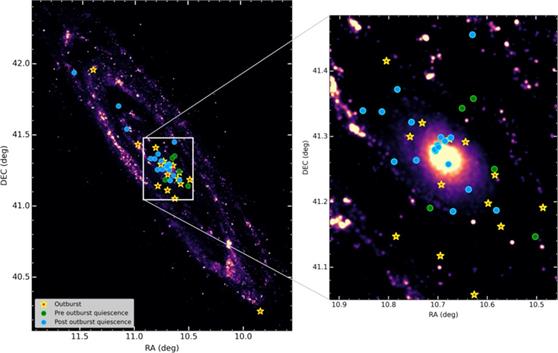
Bengaluru: In a groundbreaking discovery, astronomers have detected far ultraviolet (FUV) emissions from novae—a type of stellar explosion—during their outburst phase in the neighboring Andromeda galaxy. This marks the first time such emissions have been observed outside the Milky Way, opening new avenues to study these transient astronomical phenomena.
Novae occur in binary star systems where a white dwarf—a dense, Earth-sized star—gravitationally draws matter from its companion, often a Sun-like star or its evolved version. As this material accumulates on the white dwarf’s surface, it triggers intense nuclear fusion, resulting in a dramatic eruption visible as a sudden bright star that fades over weeks or months.
These explosions are significant for galactic chemical enrichment and provide insights into extreme conditions like thermonuclear processes and binary star evolution.
A team of scientists from the Indian Institute of Astrophysics (IIA), Bengaluru, utilized data from the Ultraviolet Imaging Telescope (UVIT) aboard India’s AstroSat to analyze novae in Andromeda. They identified ultraviolet emissions from 42 novae, including four caught in their outburst phase.
“UVIT’s fine spatial resolution and ability to observe in far UV and near UV simultaneously enabled us to detect accretion disks around these systems, 2.5 million light-years away,” said Judhajeet Basu, a PhD student at IIA and the project lead.
Accretion disks form as the white dwarf pulls material from its companion star. The brighter the disk, the faster it consumes matter. The team observed stable accretion processes in these systems, while also identifying two novae in a quiescent state, described as the “calm before the storm.”
The team leveraged UVIT’s advanced imaging capabilities to study flux changes in different UV bands. The bright core of the Andromeda galaxy posed challenges, prompting the use of sophisticated image subtraction techniques to identify novae against the galaxy’s luminous backdrop.
“We used two different image subtraction methods, and both confirmed our findings,” said Sudhanshu Barway, a faculty member at IIA.
The study, published in the Astrophysical Journal, highlights the potential of UV and X-ray astronomy to unlock mysteries of stellar evolution. “Tracing these novae was possible only because of the Andromeda survey proposals taken up by AstroSat UVIT,” said Basu.
Bhubaneswar: From a proposed international airport to the restoration of historic religious sites, Odisha Chief…
Bhubaneswar, October 12: Students across Odisha have showcased their ideas for a developed India through…
Bhubaneswar: More than 170 students and vocational lecturers from Government Vocational Higher Secondary Schools across…
Bhubaneswar: East Coast Railway (ECoR) is expanding its technology-driven security network, with plans to increase…
Bhubaneswar: Odisha’s traditional handloom and handicraft heritage took centre stage at Bhubaneswar Times Fashion Week…
Bhubaneswar: With physical tests for the recruitment of Foresters, Forest Guards and Excise Constables set…