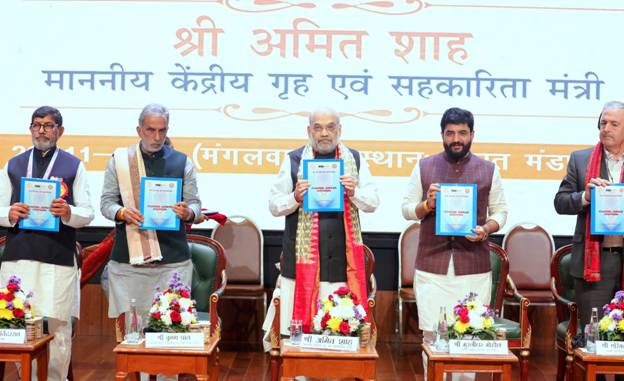
New Delhi: Union Home Minister and Minister of Cooperation, Amit Shah, today marked the Diamond Jubilee Celebrations of the National Federation of State Co-operative Banks Limited (NAFSCOB) and the national meeting of Rural Cooperative Banks at Bharat Mandapam in New Delhi. The event was attended by several dignitaries, including Union Ministers of State for Cooperation, Krishan Pal and Muralidhar Mohol, and the Secretary of the Ministry of Cooperation.
In his address, Amit Shah highlighted the dual significance of celebrating the Diamond Jubilee of any institution: to honor its achievements over the past 60 years and to reflect on areas for improvement. He emphasized the critical role of the three-tiered cooperative structure—Primary Agricultural Credit Societies (PACS), district-level, and state-level banks—in supporting India’s agricultural growth and ensuring the nation’s economic journey over the past 75 years of independence.Shah stressed that the cooperative sector, through its seamless disbursement of short-term agricultural loans to approximately 13 crore farmers, has breathed new life into the agriculture sector. The system, which connects grassroots farmers to state and district banks, has also contributed to a variety of sectors, including collective farming, water management, and rural development.
Looking ahead, the Minister outlined that under Prime Minister Narendra Modi’s leadership, India is transitioning from ‘Sahkar Se Samriddhi’ (prosperity through cooperation) to ‘Samriddhi Se Sampoornata’ (from prosperity to completeness). He emphasized that the Ministry of Cooperation’s role aligns with the vision of inclusive economic growth, ensuring that the benefits of development are felt by all citizens, including farmers, rural populations, Dalits, tribals, and women.
The Minister also mentioned India’s goal of becoming the world’s third-largest economy by 2027 and stressed that the cooperative sector would play a key role in this transformation. Referring to Mahatma Gandhi’s vision of Gramin Swaraj (rural self-rule), Shah reiterated the government’s commitment to empowering rural areas through the cooperative model.
Shah acknowledged that the cooperative sector faces two significant challenges: unequal treatment and the lack of a seamless legal framework. He called for overcoming these obstacles, which he believes will allow the cooperative sector to flourish in the next five years. He also stressed the potential for India’s cooperative sector to become a global leader in guiding the development of similar sectors worldwide.
The Minister highlighted the historical significance of NAFSCOB, which was established in 1964 by Dr. Dhananjayrao Ramchandra Gadgil and Maganbhai Patel. He praised NAFSCOB for its invaluable role in helping guide district and state-level banks and its ability to maintain precise data, with a transparency rate of 99.72%, on over 100 key parameters of cooperative banks.
Amit Shah emphasized the need for technological upgrades within PACS to ensure transparency and viability. He called for a shift from traditional approaches and encouraged the youth to take an active role in modernizing cooperative practices. Strengthening the cooperative structure, from PACS to district and state cooperative banks, was identified as essential for the sector’s success.
Additionally, the Minister stressed the importance of increasing transparency within cooperative banks and urged PACS, district cooperative banks, and state cooperative banks to work together towards this goal.
Shah also outlined ambitious financial targets for the cooperative sector. He announced that Rs. 4.33 lakh crore is deposited in District Cooperative Banks and Rs. 2.42 lakh crore in State Cooperative Banks, setting a goal to increase these deposits. He emphasized the need for a cooperative ecosystem where all cooperative bodies’ accounts are consolidated within district cooperative banks, leading to a 20% increase in low-cost deposits. This, in turn, would boost profits and enhance the lending capacity of cooperative banks.
The Minister underscored that the viability of PACS is crucial for the continued success of district and state cooperative banks. He highlighted several government initiatives to modernize PACS, including updating their bye-laws, allowing them to manage activities like Jan Aushadhi Kendras, dairies, and fishermen’s committees. Furthermore, PACS have received licenses for fertilizers and drugs, and many have been transformed into Common Service Centers (CSCs) to provide over 300 services in rural areas.
Looking forward, Shah set an ambitious goal of establishing district cooperative banks in 80% of India’s districts within the next five years. This expansion, he said, would play a key role in strengthening the cooperative sector.
Finally, Shah called for NAFSCOB to continue its efforts in making PACS more viable, transparent, and technologically advanced. He suggested that the cooperative sector’s future success hinges on the total computerization of PACS and the exploration of long-term financing options through PACS, which would further boost their business growth.
The Union Minister concluded by reaffirming the potential of the cooperative sector to drive India’s economic growth, stating that providing prosperity to the country’s 140 crore citizens can only be achieved through cooperative models that ensure equal development for all.
Chhatrapur: With Ganjam district likely to experience heavy rainfall and strong winds on November 18…
Bhubaneswar: India's U20 Women's rugby team made an impressive start to the Asia Rugby Emirates…
Bhubaneswar: The three-day State-Level Children’s Festival ‘Suravi-2026’, celebrating the creativity and talents of school students…
New Delhi: Odisha showcased its rich cultural heritage, traditional craftsmanship, indigenous products and emerging economic…
Bhubaneswar: Emphasising the importance of early childhood care, parental involvement and learning through play, the…
Bhubaneswar: The Odisha Government has approved five Instream Storage Structure (ISS) projects worth ₹625.47 crore…